
আরও দেখুন


 14.05.2026 04:00 AM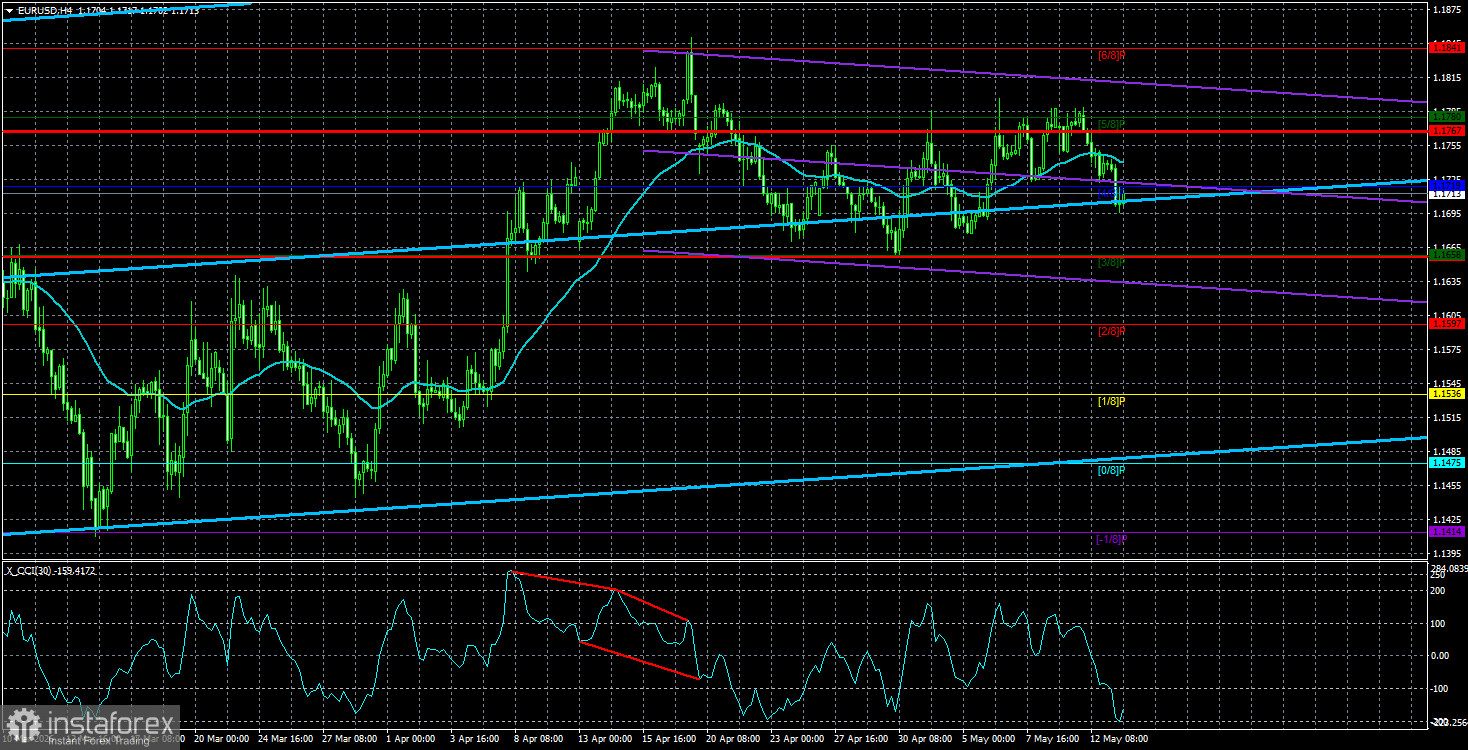
The EUR/USD currency pair slid slightly in price on Wednesday, but the 4-hour chart shows the movements remain weak and corrective. The same conclusion can be drawn from the chart below—volatility over the last 5 days did not exceed 65 pips. This is certainly not too low, but it is also far from being very high. Thus, we are currently witnessing another wave of downward movement within what is, in practice, a sideways movement. Although the movements of the last few weeks cannot be labeled as a "flat," a clear trend is also absent. The market is constantly oscillating between buying and selling amid an ever-changing geopolitical backdrop, while macroeconomic and fundamental factors remain ignored.
A striking example is that in the last few days, several European Central Bank representatives have stated that the central bank may raise interest rates as early as June. This time, "may raise" indicates not a hypothetical possibility but a practically predetermined step. The problem is that inflation in the Eurozone continues to accelerate, and since Donald Trump is not looming over the ECB (as he is over the Federal Reserve), the ECB can fully carry out its mandates. Therefore, if the war in the Middle East does not end before early June and the Strait of Hormuz remains closed, the ECB's decision to tighten monetary policy can be considered made.
How did the market react to this news? Just as it did to the inflation report, labor market data, and unemployment figures in the US, meaning, hardly at all. Perhaps there was minimal market reaction, but since when do traders need to pore over charts for responses to such important reports?
Thus, we continue to believe the market is trading exclusively on geopolitical news, even as this factor's impact on the market has been weakening. In practice, this looks straightforward. Traders are still ready to respond to the most critical news, but they are no longer inclined to systematically buy dollars because the conflict is ongoing, may flare up anew, and the Strait remains blocked. Therefore, for a significant rise in the US currency, a resumption of war in the Middle East is required. Neither Trump nor Iran wants that. Consequently, we believe that the likelihood of the conflict transitioning into a prolonged, multi-month phase of negotiations while maintaining the status of a temporary ceasefire is the best available outcome in the current situation. There will be no peace without a deal. War is undesirable for everyone. The only way forward is to keep negotiating. Notably, Tehran and Washington have not made any statements about withdrawing from negotiations, meaning that talks will continue.
The market is currently in a state of anticipation. Negotiations are going well, but traders want to understand their current stance. Negotiations represent the absence of peace and the absence of war. Therefore, there are currently no grounds for either buying or selling the pair.
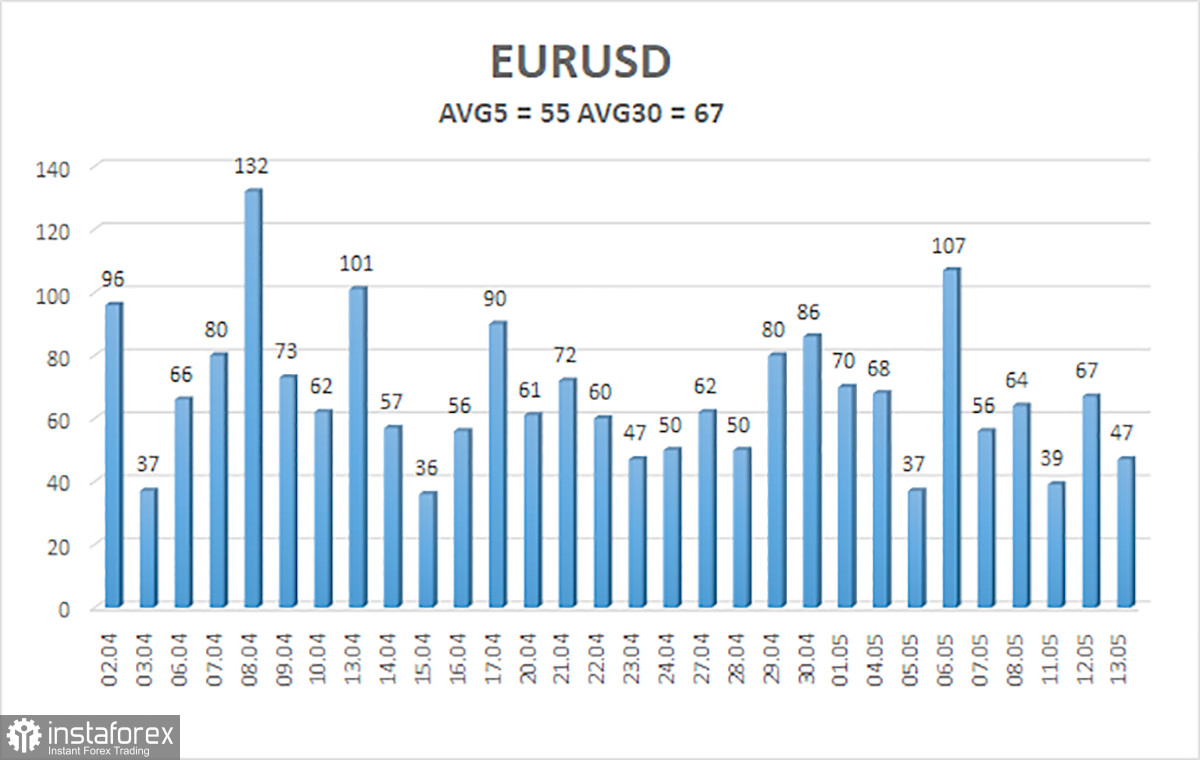
The average volatility of the EUR/USD currency pair over the last 5 trading days as of May 14 is 55 pips, which is characterized as "average." We expect the pair to trade between 1.1658 and 1.1767 on Thursday. The upper channel of the linear regression has turned sideways, indicating a potential trend change to the upside. In fact, the upward trend for 2025 could have resumed a month ago. The CCI indicator has entered the overbought zone and formed two "bearish" divergences, signaling the start of a downward correction that is likely already complete.
S1 – 1.1658
S2 – 1.1597
S3 – 1.1536
R1 – 1.1719
R2 – 1.1780
R3 – 1.1841
The EUR/USD pair maintains an upward trend amid the weakening influence of geopolitics on market sentiment and diminishing geopolitical tensions. The global fundamental backdrop for the dollar remains extremely negative, so we continue to expect long-term growth in the pair.
If the price is positioned below the moving average, short positions can be considered with targets at 1.1658 and 1.1597 on technical grounds. Above the moving average line, long positions are relevant with targets at 1.1841 and 1.1902. The market continues to distance itself from geopolitical factors, and the dollar continues to lose its only support for growth.


