
আরও দেখুন


 15.09.2026 09:37 AM
Bitcoin attempted to storm the $79,000 level yesterday — but again without success.
Tomorrow, September 16, the market will have reason for a much more long-term reaction than the usual ETF-flow updates. The House Financial Services Committee will vote on H.R. 8957, the "American Reserve Modernization Act" of 2026, which would for the first time convert a strategic Bitcoin reserve from a presidential executive order into a binding federal statute. That is a crucial difference: an executive order signed in March last year can be rescinded by the next president with a stroke of a pen, whereas a law requires a full legislative process to repeal.

A key provision of the bill is a minimum 20-year holding period for Bitcoin in the reserve with no right to sell, swap, or auction the holdings, with a single exception for paying down federal debt. That clause turns the reserve from a flexibly managed instrument into an effectively frozen asset over a very long horizon — beneficial for long-term holders and institutions aligned with the "digital gold" thesis, but it removes flexibility from the Treasury in the event of sudden market moves. The bill also mandates that all government-seized Bitcoin be directed into the reserve rather than sold at auction, changing current practice.
The U.S. Treasury would also be required to build the reserve's infrastructure within 180 days of the law taking effect and begin publishing quarterly reserve attestations via independent auditors. A separate article tasks authorities with exploring budget-neutral methods to add to the reserve — i.e., without new taxes, borrowing, or expanding the deficit — which contrasts with proposals to fund purchases by selling part of gold reserves or revaluing the Federal Reserve's balance sheet.
Recall that Republican Nick Begich and Democrat Jared Golden introduced the bill, and its 23 co-sponsors include members of both parties, which reduces the risk of purely partisan blockage at later stages. Nevertheless, committee passage guarantees nothing beyond the right to be considered on the House floor: the bill would still face a Senate vote with a 60-vote threshold, where the fate of the CLARITY Act showed how difficult it can be to secure such a supermajority even on broadly industry-supported measures.
I do not rule out a muted market reaction to the committee vote itself, since at least two significant hurdles remain before the bill becomes law. But the psychological effect of the reserve concept first advancing through a binding legislative procedure will be gradually priced in as the measure approaches a Senate vote.
As for short-term trading, the strategy and conditions are described below.
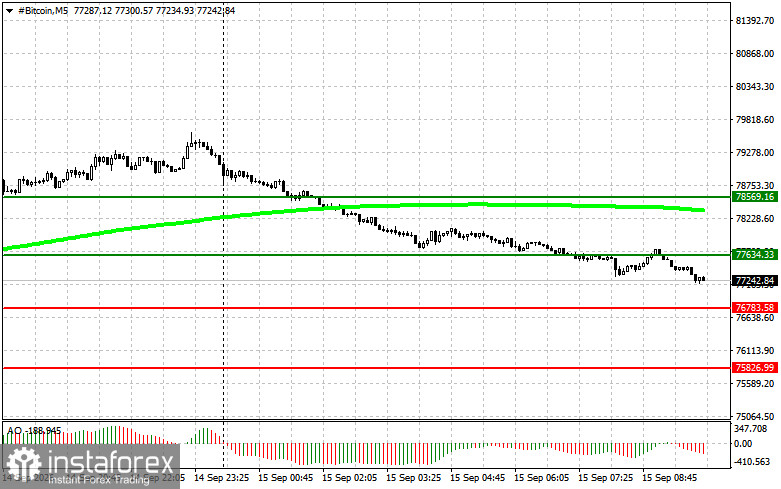
For Bitcoin, the first buy scenario is built around an entry point near $77,600. It is reasonable to open a long position at that level today, targeting a move to $78,500. Once the price reaches that mark, it makes sense to close the long and immediately flip into a short, playing the likely bounce down after the level performs as resistance. Before entering this breakout scenario, be sure to check two indicators: the 50-day moving average must be below the current price, and the Awesome Oscillator must be trading in positive territory, above zero. Without meeting both conditions, the buy signal is not confirmed.
The second buy scenario for Bitcoin is structured differently — from the lower boundary of the range at $76,700. The logic here is to wait for an attempt to break this boundary to the downside and confirm the market did not support that attempt—i.e., no continuation of the decline followed. In that case, open a buy position off the rejection, with the familiar targets $77,600 and $78,600 as potential upside references once the failed breakout reverses.
On the sell side, the first scenario is also tied to the $76,700 level, but as an entry point for a short position on a confirmed break below this boundary. The target in this scenario is effectively the same $76,700, which means trading off the breakout and subsequent consolidation below it; after that, one should lock in profits on the short and immediately reverse into a buy to catch the technical bounce. Entry conditions are the mirror of the first buy scenario: the 50-day moving average should be above the current price, and the Awesome Oscillator must be in negative territory, below zero.
The second sell scenario is linked to the upper boundary at $77,600. Here, wait for an attempted upside breakout and confirm the absence of market follow-through—the price should not consolidate above it. In that case, open a sell position on the rejection, with targets at $76,700 and further down at $75,800.
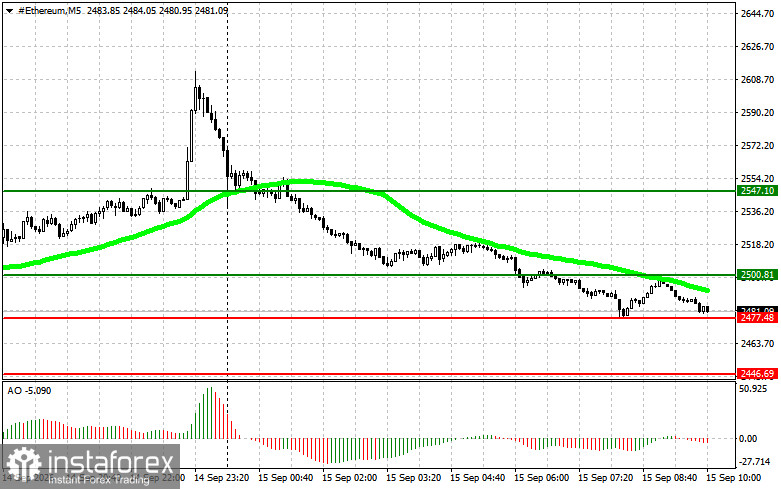
For Ether, the first buy scenario begins at an entry point around $2,500, from which a move to the $2,547 target is expected. Once that level is reached, the long position is closed and replaced with a short to play the downside rejection from resistance. Entry conditions are standard for breakout longs: the 50-day moving average must be below the current price and the Awesome Oscillator above zero.
The second buy scenario for Ether is formed from the lower boundary at $2,477. Here too, you need a failed downside breakout, after which price returns into the range; recovery targets are $2,500 and $2,547.
The first sell scenario for Ether opens from $2,477 on a confirmed break below that level, targeting $2,446. After the target is reached, close the short, and open a buy to catch the rebound. Conditions are mirrored: the 50-day moving average should be above price, and the Awesome Oscillator should be below zero.
The second sell scenario for Ether is tied to the upper boundary at $2,500, where — if an upside breakout fails and there is no follow-through — a sell is opened off the rejection, with downside targets at $2,477 and $2,446.


