
See also


 03.03.2026 08:39 AM
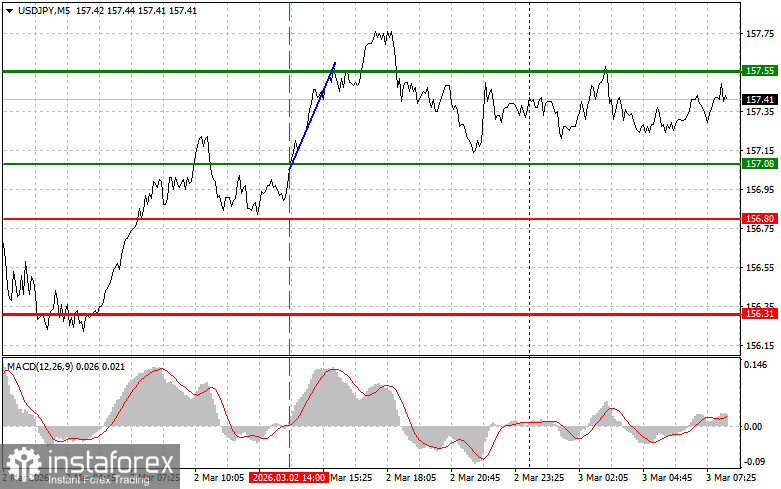
The price test at 157.08 coincided with the MACD indicator just starting to move above the zero mark, confirming the correct entry point for buying the dollar. As a result, the pair rose to the target level of 157.55.
Meanwhile, the Japanese yen is actively losing ground against the US dollar, and Finance Minister Satsuki Katayama stated that Japan is closely monitoring the financial markets and will take all necessary actions in response to sharp fluctuations in the exchange rate of the national currency, as volatility is increasing again after the US and Israel's attack on Iran.
The sharp yen weakness observed in recent weeks is once again causing serious concern for the government. Exporters may benefit from a weaker currency, but the rising cost of imports, especially energy resources and food in the face of a potential new energy crisis due to the war between the US and Iran, could increase price pressure in the country. This imbalance, exacerbated by external shocks, creates a complex dilemma for the government and the Bank of Japan. Authorities want softer policies, while the Japanese central bank insists on raising rates to bring inflation back to the target level of 2.0%.
As for the intraday strategy, I will rely more on implementing scenarios No. 1 and No. 2.
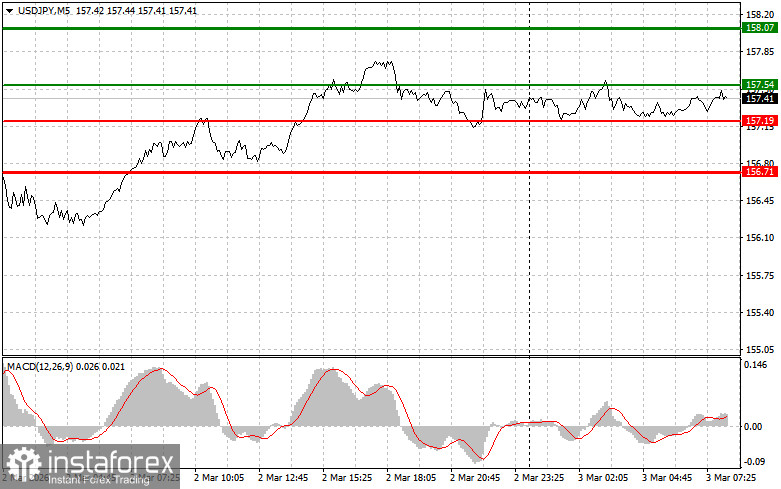
Scenario No. 1: I plan to buy USD/JPY today if the entry point reaches around 157.54 (green line on the chart), with a target at 158.07 (thicker green line on the chart). Around 158.07, I plan to exit the long positions and open shorts back (expecting a 30-35-pip move in the opposite direction from the level). It is best to return to buying the pair during corrections and serious pullbacks in USD/JPY. Important! Before buying, ensure the MACD indicator is above the zero mark and just beginning to rise from it.
Scenario No. 2: I also plan to buy USD/JPY today if there are two consecutive tests of 157.19 while the MACD indicator is in the oversold area. This will limit the pair's downside potential and lead to an upward market reversal. An increase to opposite levels of 157.54 and 158.07 can be expected.
Scenario No. 1: I plan to sell USD/JPY today only after the 157.19 level is updated (red line on the chart), which will trigger a rapid decline in the pair. The key target for sellers will be the 156.71 level, where I plan to exit the shorts and open immediate longs in the opposite direction (expecting a 20-25-pip move in the opposite direction from the level). It is better to sell as high as possible. Important! Before selling, ensure the MACD indicator is below the zero mark and just beginning to drop.
Scenario No. 2: I also plan to sell USD/JPY today if there are two consecutive tests of 157.54 while the MACD indicator is in the overbought area. This will limit the upward potential of the pair and lead to a market reversal downward. A decrease to opposite levels of 157.19 and 156.71 can be expected.
Important: Beginner traders in the forex market need to make entry decisions very carefully. It is best to stay out of the market before the release of important fundamental reports to avoid sharp fluctuations in prices. If you choose to trade during the release of news, always set Stop Loss orders to minimize losses. Without placing Stop Loss orders, you can quickly lose your entire deposit, especially if you do not use money management and trade large volumes.
And remember, successful trading requires a clear trading plan, like the one presented above. Making spontaneous trading decisions based on the current market situation is inherently a losing strategy for intraday traders.


