
See also


 19.06.2026 08:00 AM
The price test at 161.05 coincided with a moment when the MACD indicator was just beginning to move upward from the zero mark, confirming a correct entry point to buy dollars. As a result, the pair rose to around 161.57.
The Japanese yen continues to decline sharply against the U.S. dollar, reaching its lowest level in four decades. This troubling trend is unfolding amid clear signals of potential currency intervention from Japan, which has previously warned of its readiness to take bold action to protect its national currency. Despite these ominous warnings, the yen continues to lose ground, indicating market uncertainty about the effectiveness of potential steps from Tokyo or the strength of dollar pressure.
The weakness of the yen raises serious concerns in Japan, as imported goods, including raw materials and energy, are becoming significantly more expensive, undermining the purchasing power of the population and increasing costs for businesses. The Bank of Japan had previously maintained an ultra-loose monetary policy despite rising inflation in other countries, contributing to the yen's weakness. However, the current sharp decline occurring after a recent rate hike is puzzling. It appears that traders are waiting for more aggressive steps from the U.S. Federal Reserve, which is escalating carry-trade activity. The interest rate differential between the U.S. and Japan may become more apparent, making the dollar attractive for investment and creating sustained demand for U.S. currency. This divergence in monetary policies between the two central banks is a key driver of the current dynamics in the USD/JPY currency pair.
As for the intraday strategy, I will primarily rely on the implementation of scenarios #1 and #2.
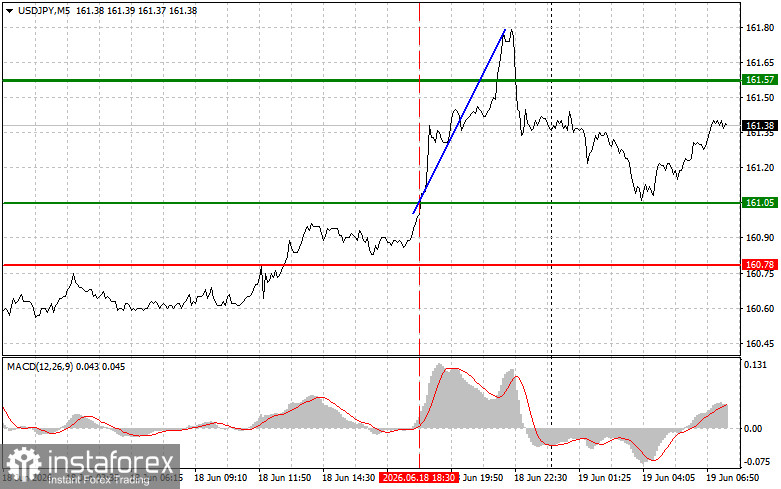
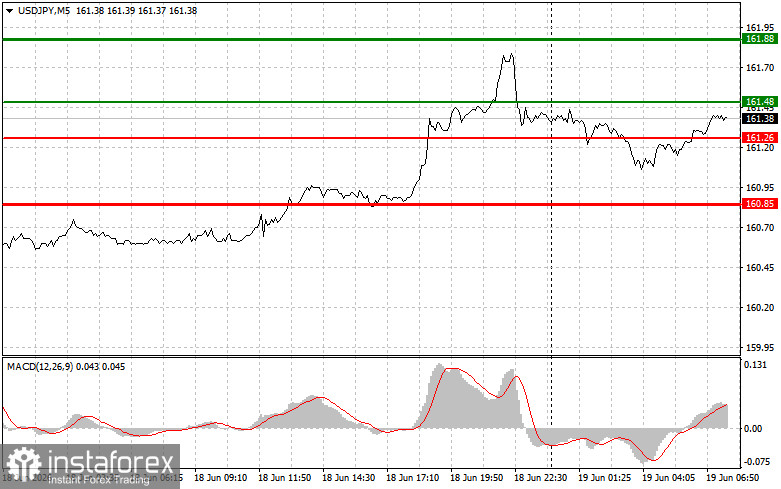
Thin green line – entry price for buying the trading instrument;
Thick green line – presumed price level for placing Take Profit or manually securing profits, as further growth above this level is unlikely;
Thin red line – entry price for selling the trading instrument;
Thick red line – presumed price level for placing Take Profit or manually securing profits, as further decline below this level is unlikely;
MACD Indicator. When entering the market, it is important to consider the overbought and oversold zones.
Important: Beginner traders in the Forex market must be very cautious when making entry decisions. Before major fundamental reports are released, it is best to stay out of the market to avoid being caught in sharp fluctuations. If you decide to trade during news releases, always set stop orders to minimize losses. Without setting stop orders, you can quickly lose your entire deposit, especially if you are not using money management and are trading large volumes.
And remember, for successful trading, you need a clear trading plan similar to the one presented above. Making spontaneous trading decisions based on the current market situation is inherently a losing strategy for intraday traders.


