
Lihat juga


 05.03.2026 08:38 PM
The GBP/USD pair continues to decline within a bullish trend. The only active pattern remains bearish imbalance 16, but the bulls missed it by just 6–7 points last week and failed to touch it and form a signal. This could have produced a good profit if you trade against the trend. Personally, I try to follow signals that align with the trend rather than trade against it, but situations differ and every trader makes their own decisions.
At the moment, I can say only one thing: the market has already experienced the beginning of the war in the Middle East. The further decline of the pair will now depend on how many countries become involved in the conflict and which countries—beyond the immediate region—Iran may strike.
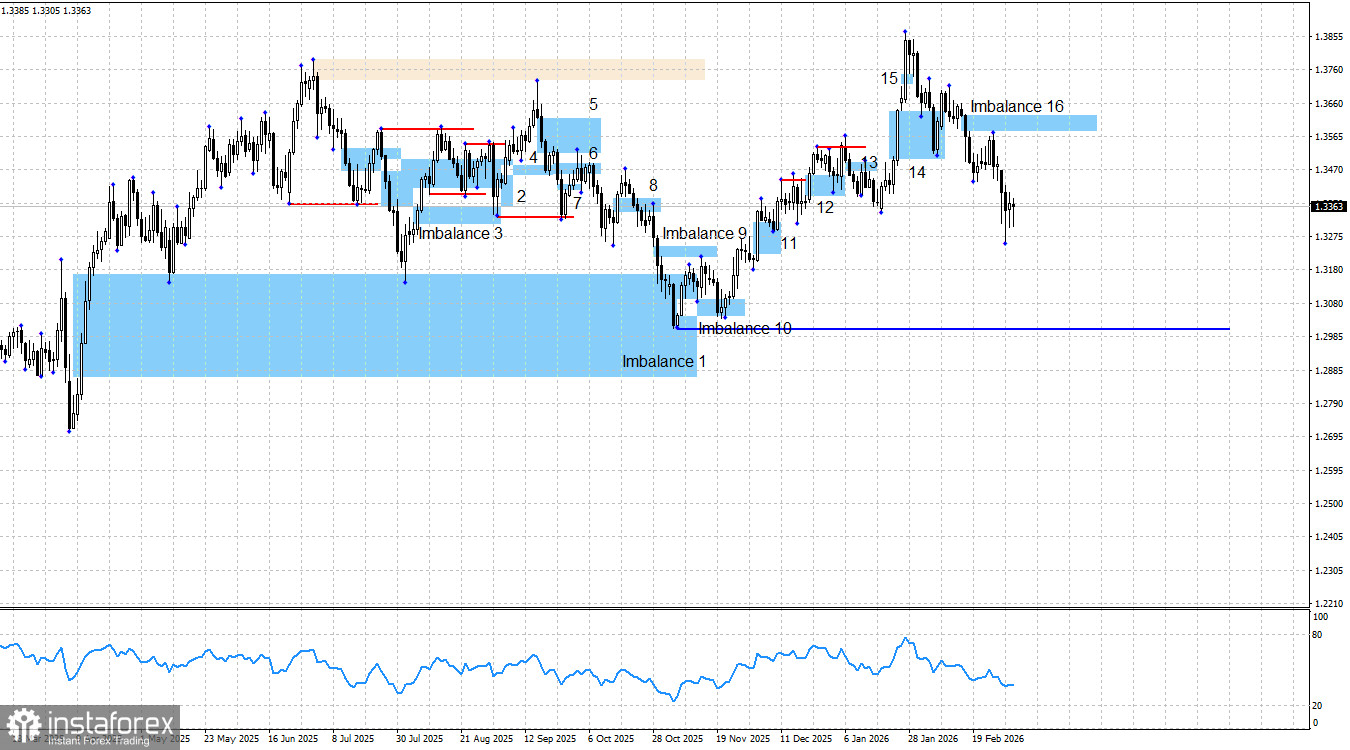
With enough effort, it is currently possible to identify two liquidity grabs on the daily chart from bearish swings dated December 17 and January 19. I prefer working with more obvious swings, and I would like to remind you that a liquidity grab is neither a pattern nor a trading signal. At present, there are no bullish patterns, and the price is unlikely to return to imbalance 16 soon and produce a signal on a second attempt.
In my view, if there is no further escalation in the Middle East in the next few days, the British pound may gradually begin to recover. However, important labor market and unemployment reports will be released in the United States tomorrow, which could support the bears. In that case, instead of the pound rising based on the technical picture, we may see the U.S. dollar strengthen again against the trend.
The bullish trend for the pound remains intact. Therefore, as long as it holds (above 1.3012), I would pay more attention to bullish signals. The pound's decline may be quite strong, but it could also end at any moment. The only currently active pattern, imbalance 16, has not produced any signal so far. No new bearish patterns are expected this week either. As a result, market attention may shift to U.S. economic reports and technical analysis.
The news background on Thursday was absent, as no data came from the United Kingdom, while in the United States the report on initial jobless claims was released, which under current circumstances attracted little interest.
In the United States, the overall news background remains such that, in the long term, little can be expected other than a decline in the dollar. The war between Iran and the United States has changed little so far. For the U.S. dollar, the situation remains rather difficult in the long term but quite positive in the short term. However, the key point is that this positivity exists only in the short term.
U.S. labor market statistics continue to disappoint more often than they encourage. Three of the last four FOMC meetings ended with dovish decisions. Trump's military actions, threats toward Denmark, Mexico, Cuba, Colombia, EU countries, Canada, and South Korea, the criminal case against Jerome Powell, government shutdowns, the scandal involving the U.S. elite in the Epstein case, the possibility of Trump's impeachment by the end of the year, and the very likely defeat of Republicans in upcoming elections all contribute to the picture of a political and structural crisis in the United States. In my opinion, bulls have every reason to resume their advance during 2026.
For a bearish trend to form, the U.S. dollar would need a strong and stable positive news background, which is difficult to expect under Donald Trump. Therefore, I still do not believe in a bearish trend for the pound. Too many risk factors remain weighing heavily on the dollar. Selling positions could theoretically be considered based on bearish patterns, but personally I would not recommend this to traders. I believe the recent decline of the pair was, to some extent, the result of an unfortunate combination of circumstances.
Economic calendar for the United States and the United Kingdom
On March 6, the economic calendar contains at least two important events. The influence of the news background on market sentiment on Friday may be strong, particularly in the second half of the day.
GBP/USD forecast and trader advice
For the pound, the broader picture remains bullish, although the short-term picture has turned bearish. At the moment there are no active bullish patterns. The only element present is bearish imbalance 16, to which the price must first return and show a reaction before traders can consider the potential opening of short positions.
It should be noted that the pound's decline over the past few weeks has been strong enough to temporarily transform the bullish picture into a bearish one due to an unfortunate chain of events. If Donald Trump had not repeatedly threatened to attack Iran, sent military ships to the Persian Gulf, and then started a war, we likely would not have seen such a strong drop. I believe this decline could end as unexpectedly as it began. In my opinion, the trend has not turned bearish in recent weeks.


