
Lihat juga


 15.06.2026 12:52 AM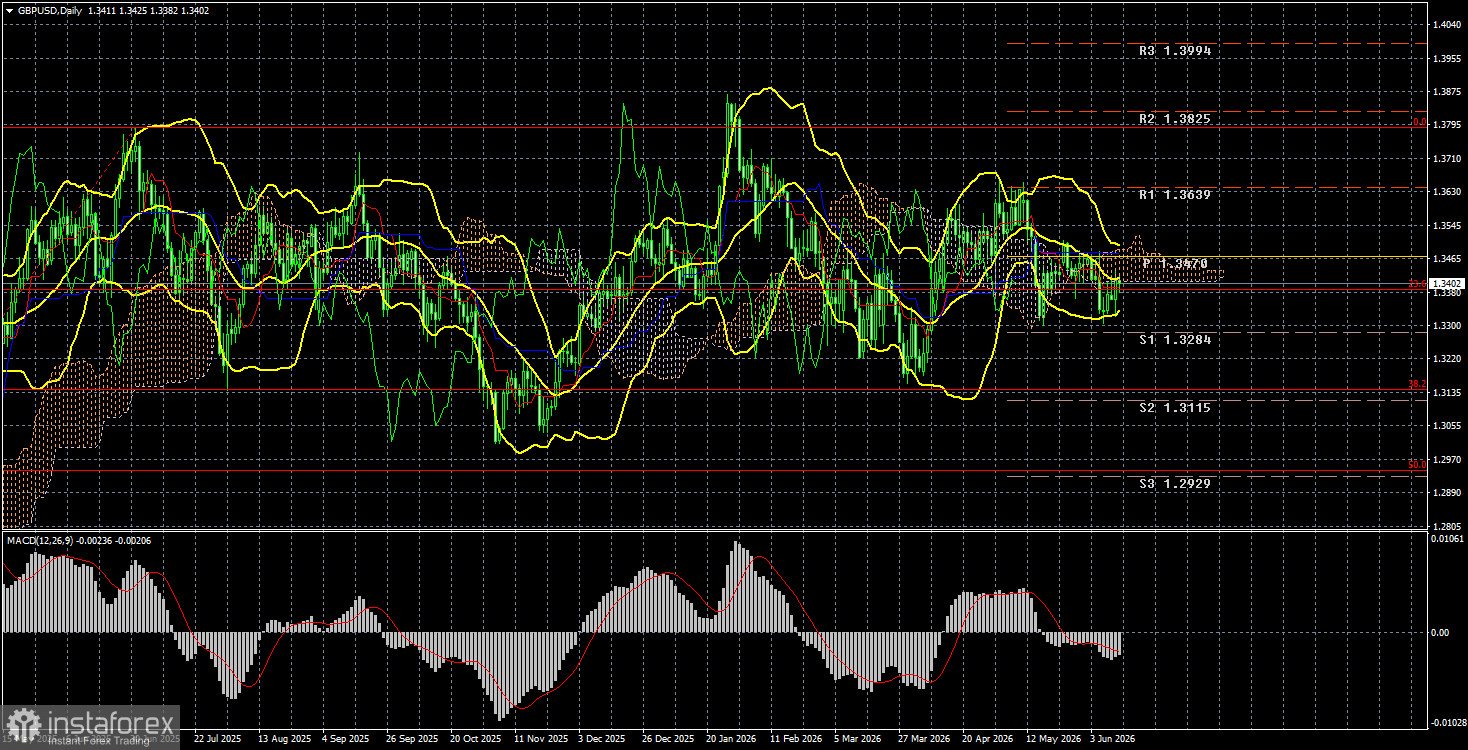
The GBP/USD currency pair is awaiting a verdict from the Middle East. In our previous reviews, we regularly mentioned that the key and, in fact, the only supporting factor for the US dollar in 2026 is geopolitics. Even with such a strong motivation for purchases, the US dollar has failed to show significant growth. This is clearly visible in the daily charts of EUR/USD and GBP/USD. The lateral correction in the euro currency began in July of last year. Since then, the pair has spent most of its time trading between 1.1410 and 1.1840. Before the onset of the war in the Middle East, it moved out of this range and clearly intended to continue a global upward trend. But the war began, and the dollar... simply returned to the 1.1410-1.1840 range, where it has traded to this day.
The situation with the GBP/USD pair is similar. In January of this year, it broke the previous three-year high and clearly intended to continue the upward trends of 2025 and 2022. But it did not happen. As a result, the British pound entered yet another correction, failing to even drop below the previous local low. Thus, with the war in Iran, the US currency received support, but the overall global technical picture did not change significantly. The US dollar only received a reprieve from a new decline.
The second key supporting factor for the US currency, which appeared just a couple of weeks ago, is the Federal Reserve's tighter monetary policy stance. As inflation in the US has nearly doubled over the last three months, the market has reasonably begun to anticipate an increase in the key rate. Federal Reserve Monetary Committee members did not deny that a policy tightening is possible in 2026, but not now and not in the summer. Therefore, if inflation continues to escalate, we may see at most one rate hike by the end of the year. As we can see, the second supporting factor for the dollar is very weak.
If the Fed is not eager to tighten after three months of rising inflation, it is unlikely to do so if the conflict in the Middle East ends, the Strait of Hormuz is opened, and oil prices fall. With the conclusion of the conflict between Iran and the US, two supporting factors for the dollar could be eliminated at once. Thus, we continue to believe that, in the long term, the prospects for the US currency have not changed. It still faces a decline due to Donald Trump's policies.
If the conflict in the Middle East is not resolved or if the nuclear negotiations between Tehran and Washington fail, it will again be difficult for the pound and the euro to resume an upward trend, but this does not mean that they will plummet down at lightning speed. The most challenging period (February-March), when the war had just begun, and the whole world was experiencing an energy shock, is already behind us. In June 2026, no one will be surprised by military actions in the Persian Gulf. Middle Eastern countries are gradually learning to export oil bypassing the Strait of Hormuz, and the only remaining threat now is the blockade of the Bab-el-Mandeb Strait. Therefore, we believe that only the blockade of the Bab-el-Mandeb Strait could provoke a strong rise in the US dollar. Or a new war from Trump.
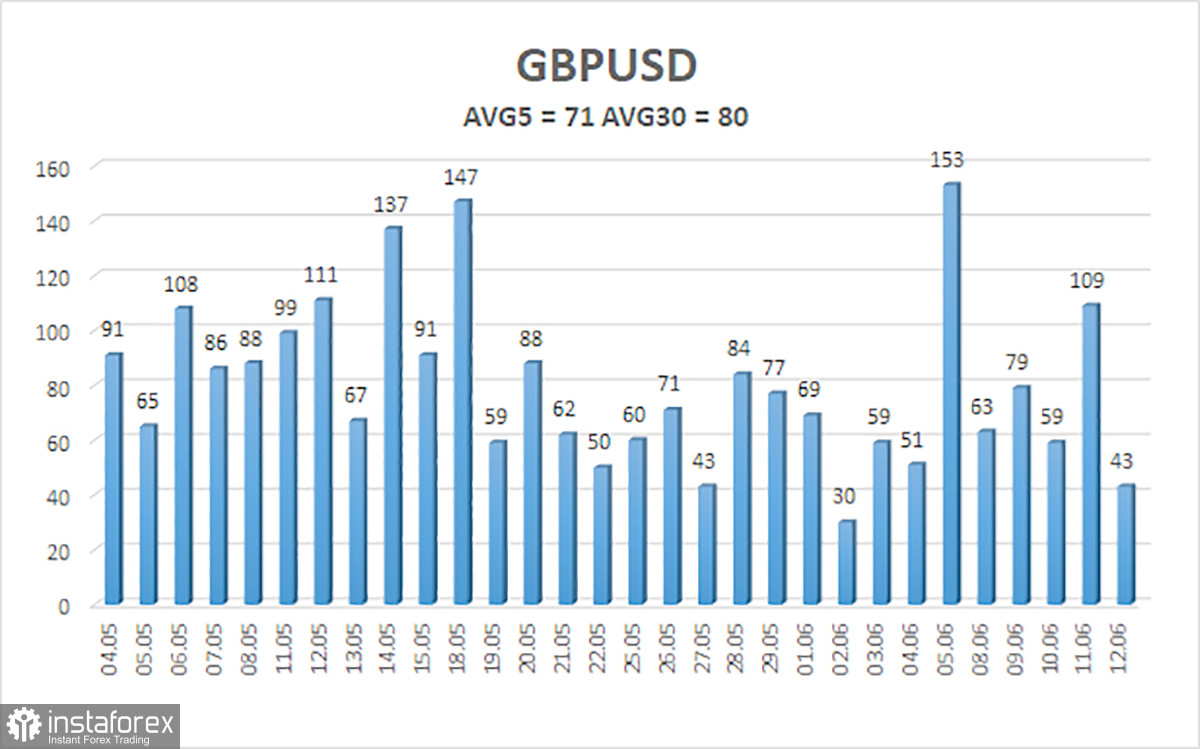
The average volatility of the GBP/USD pair for the last 5 trading days is 71 pips. For the pound/dollar pair, this value is considered "average." On Monday, June 15, we thus expect movement within a range defined by levels 1.3331 and 1.3473. The upper channel of linear regression is directed upward, indicating a recovery of the upward trend. The CCI indicator has entered oversold territory, signaling a possible end to the downward trend.
S1 – 1.3367
S2 – 1.3306
S3 – 1.3245
R1 – 1.3428
R2 – 1.3489
R3 – 1.3550
The GBP/USD currency pair maintains a downward trend. Trump's policies will continue to exert pressure on the US economy, so we do not expect long-term growth from the US dollar. However, 2026 is proving super-positive for the dollar due to geopolitical factors. Thus, long positions targeting 1.3489 and 1.3550 can be considered when price is above the moving average. A price position below the moving average line will allow for trading down with targets of 1.3331 and 1.3306. The market situation is often changing, and the market continues to track predominantly geopolitical news, which lacks a uniform character.
Linear regression channels help determine the current trend. If both are directed in the same way, the trend is strong right now;
The moving average line (settings 20,0, smoothed) defines the short-term trend and the direction in which trading should currently be conducted;
Murray levels – target levels for movements and corrections;
Volatility levels (red lines) – a probable price channel in which the pair will spend the next day, based on current volatility indicators;
The CCI indicator – its entry into the oversold area (below -250) or into the overbought area (above +250) means a trend reversal in the opposite direction is approaching.


