
यह भी देखें


 27.01.2026 01:16 AM
On Monday, the NZD/USD pair reached the round level of 0.6000, setting a four-month high, though it has since retraced slightly.
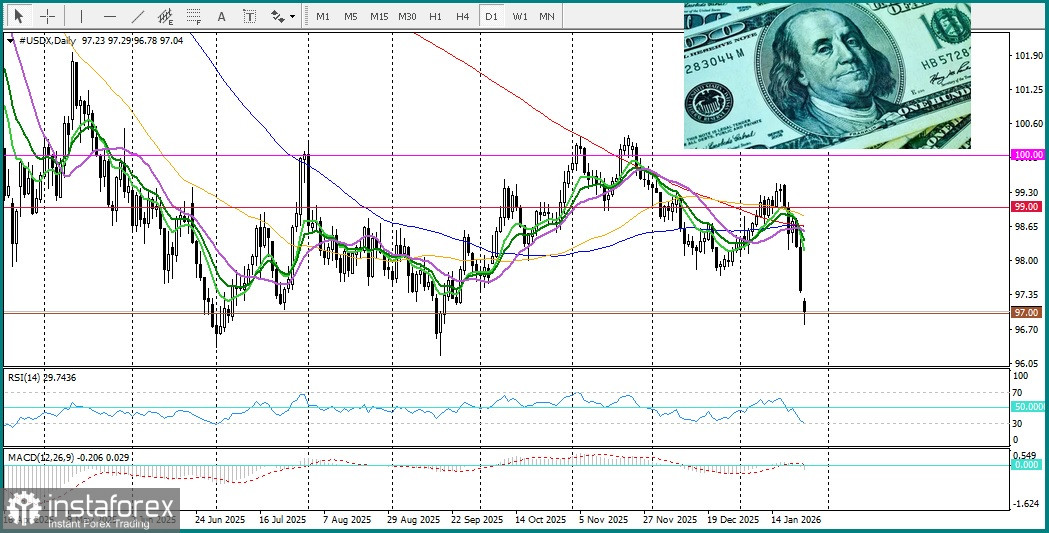
The key driver of the movement is the sharp weakening of the US dollar at the beginning of the week, centered around the Federal Reserve's monetary policy decision. The American currency is demonstrating the worst performance against all major competitors due to a combination of political and monetary factors. The prolonged uncertainty surrounding trade frictions, budget discussions in Washington, and issues of Fed independence continues to undermine investor confidence in the dollar.
Against this backdrop, the US Dollar Index (DXY), which reflects the dollar's value against a basket of six key currencies, remains near its lowest levels in recent months. The market's focus now shifts to the Fed meeting on Wednesday. It is expected that the Fed will keep rates unchanged after a series of consecutive cuts at recent meetings. Additionally, attention should be paid to the rhetoric of the accompanying statement and comments from Chairman Jerome Powell in search of signals regarding the future trajectory of monetary policy.
At the same time, the New Zealand dollar is receiving stronger internal support. Recent inflation data from New Zealand showed rising price pressures in the fourth quarter, with the consumer price index exceeding forecasts. This has renewed expectations that the Reserve Bank of New Zealand may revisit raising interest rates in the medium term, or at least maintain a tighter policy stance for longer than previously anticipated.
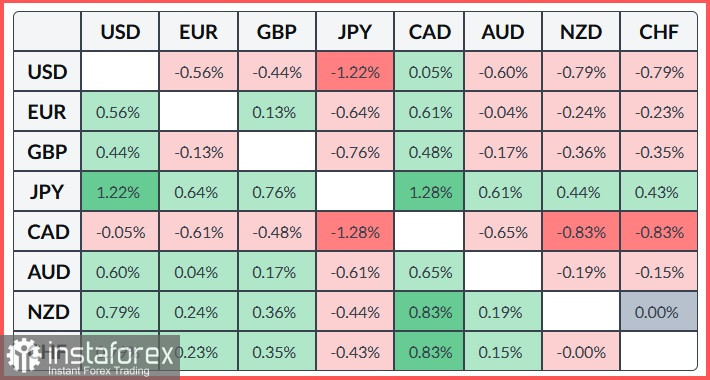
Against the backdrop of reduced dollar positions by investors, the NZD/USD pair continues to benefit from improving relative expectations for monetary policy in favor of the New Zealand currency. The table below shows the dynamics of the New Zealand dollar against major currency pairs today, with the most significant strengthening against the Canadian dollar.
From a technical perspective, the breakout above the 200-day simple moving average (SMA) last week favors the bulls. The subsequent rise above the round level of 0.5900 confirms the positive outlook, indicating that the path of least resistance for the NZD/USD pair is upward.
The Moving Average Convergence Divergence (MACD) line is positioned above the signal line in the positive zone, indicating an increase in bullish momentum. The Relative Strength Index (RSI) is in overbought territory.
As the 200-day simple moving average (SMA) levels off at 0.5868, further growth may precede a pause or shallow correction. The NZD/USD pair remains above this level, strengthening the medium-term trend. Continued growth above this moving average supports this trend.
Meanwhile, the round level of 0.6000 and the September high around 0.6003 may serve as the nearest resistance. Breaking through the 61.8% retracement level at 0.5913 indicates the weakening of the prior bearish trend. A daily candle close above the resistance would open the way for further gains, while a failure would be seen as a buying opportunity.

