
यह भी देखें


 24.06.2026 12:45 AM
Iran has agreed to international oversight of its nuclear energy and facilities. At least, this is what U.S. President Donald Trump stated on Tuesday morning. Currently, there have been no confirmations of this from Iran, so I cannot conclude whether it is true or not. However, it is noteworthy that even the U.S. president is no longer speaking of the complete destruction of all enriched uranium or the closure of all of Iran's nuclear facilities. He is only talking about control over nuclear developments. Therefore, in practice, this will look just like the nuclear deal of 2015. I can't help but wonder why it was necessary to exit the 2015 nuclear deal and start a war with Iran, only to sign a similar agreement after much difficulty and mutual concessions?
However, understanding Trump is often very difficult. The American leader insisted for four months on Iran's complete nuclear disarmament, and now it turns out that Iran essentially has the right to nuclear weapons for its self-defense. And "nuclear disarmament" in reality means "international monitoring." However, the White House leader considers Iran's agreement to allow IAEA inspections a "complete victory for the U.S." and a "great achievement." Tehran has not yet confirmed its agreement on this point and has repeatedly denied Trump's statements in the past.
Meanwhile, the market is well aware of the concessions made by the United States. Washington has allowed the export of Iranian oil, lifted the naval blockade on Iranian ports, and unfrozen a portion of Iranian funds abroad. All of this is confirmed. It currently seems that Trump has made a "mega-profitable deal," in which America receives nothing new compared to the 2015 deal, while Iran has lifted the sanctions on its oil and unfrozen its assets, which it previously could not access. It turns out that Iran has won in its confrontation with the U.S.
Undoubtedly, Trump has laid some groundwork and kept the U.S. Navy near the Persian Gulf in case the nuclear deal falls through. However, according to the American president, the likelihood of new hostilities is very low. Meanwhile, Trump's political ratings have dropped even lower, reaching record lows. 78% of Americans prefer to end the war with Iran as soon as possible, while only 22% believe that Trump signed a favorable deal with Iran (which, by the way, is still not final). Most American voters and taxpayers blame Trump for the economic crisis, citing the war with Iran as the primary cause.
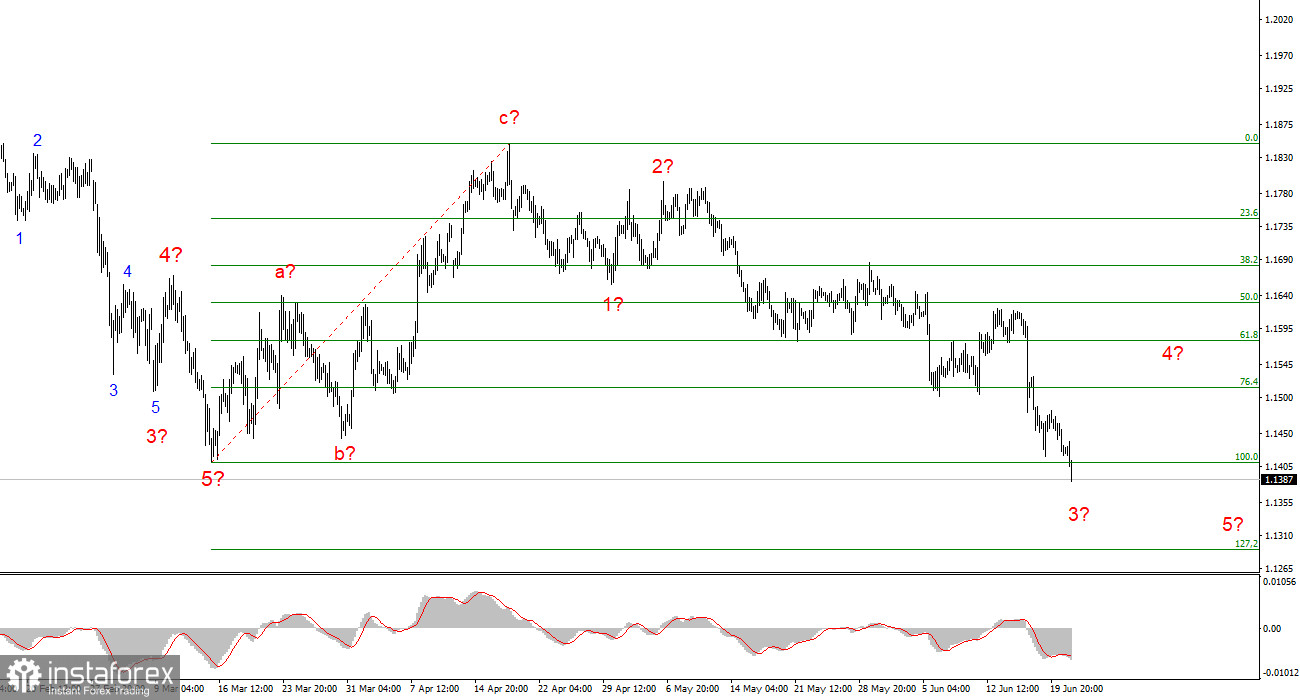
Based on the analysis of EUR/USD, I conclude that the instrument remains within an upward segment of the trend, while in the short term, it is within a downward segment that may be nearing completion. In my opinion, now is a good time to attempt to form long positions, but the instrument may drop below the 14 level within wave C. If this assumption is correct, it would be better to wait a bit, at least until wave 5 in C. Moreover, optimistic geopolitics no longer offers resistance to the U.S. dollar.
The wave structure for the GBP/USD instrument has become clearer. Currently, the instrument has formed three waves down, and EUR/USD has similarly changed to three waves. Therefore, the pound may continue to decline within wave 5 in C after a minor correction within wave 4. In any case, the downward wave sequence may conclude soon, and the news background does not provide unconditional support for the U.S. dollar. Wave C may soon drop below the low of wave A.

