
Vea también


 21.11.2025 09:14 AM
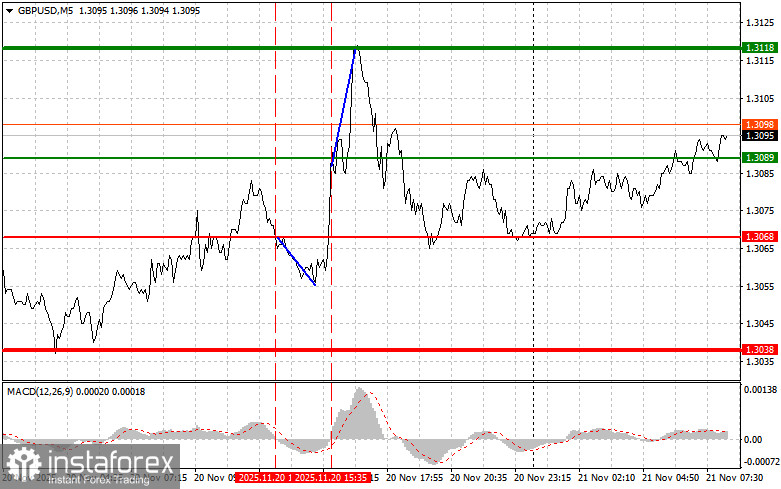
The price test at 1.3089 coincided with the MACD indicator just beginning to move up from the zero mark, confirming the correct entry point for buying the pound and leading to a rise near the target level of 1.3118.
The pound reacted positively to news that the US unemployment rate rose. Weaker-than-expected unemployment data initially pressured the US dollar, as investors became more cautious about the US economic outlook. The rise in unemployment hints at a potential slowdown in economic growth, which may lead the Federal Reserve to reconsider its restrictive stance on interest rates. However, the non-farm payroll report overshadowed the negative unemployment data. The number of new jobs created in September exceeded economists' forecasts by more than double, indicating that the labor market remains resilient. In the short term, the pound is likely to remain sensitive to economic news from both the US and the UK.
This morning will begin with information on retail sales in the United Kingdom and will conclude with the release of PMI indices for manufacturing, services, and the composite PMI index for the UK. The speech by Bank of England Monetary Policy Committee member Huw Pill is likely to be less significant compared to the data that often shapes market sentiment. Investors are particularly attentive to retail sales statistics, viewing them as an indicator of consumer spending, which is especially important amid current inflation. An increase in retail sales would be a reassuring signal reflecting the stability of the British economy, while a decline could exacerbate concerns and negatively impact the exchange rate of the British pound.
The PMI indices will provide a more comprehensive picture of the state of both the industrial and service sectors. The composite PMI index, which combines information from these two sectors, will be a key indicator of the overall economic well-being of the UK. A value above 50 indicates economic expansion, while a value below 50 signals contraction.
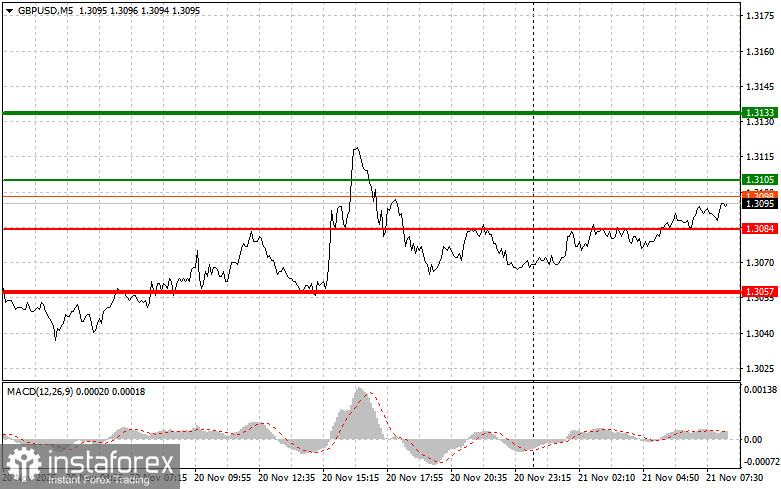
Regarding the intraday strategy, I will focus more on implementing scenarios #1 and #2.
Important: Beginner traders in the Forex market must be very cautious when making trading entry decisions. It is best to remain out of the market before the release of important fundamental reports to avoid getting caught in sharp price fluctuations. If you decide to trade during news releases, always set stop orders to minimize losses. Without setting stop orders, you can quickly lose your entire deposit, especially if you do not use money management and trade with large volumes.
And remember that successful trading requires having a clear trading plan, similar to the one I presented above. Spontaneous trading decisions based on the current market situation are inherently a losing strategy for intraday traders.


