
Vea también


 10.03.2026 07:35 PM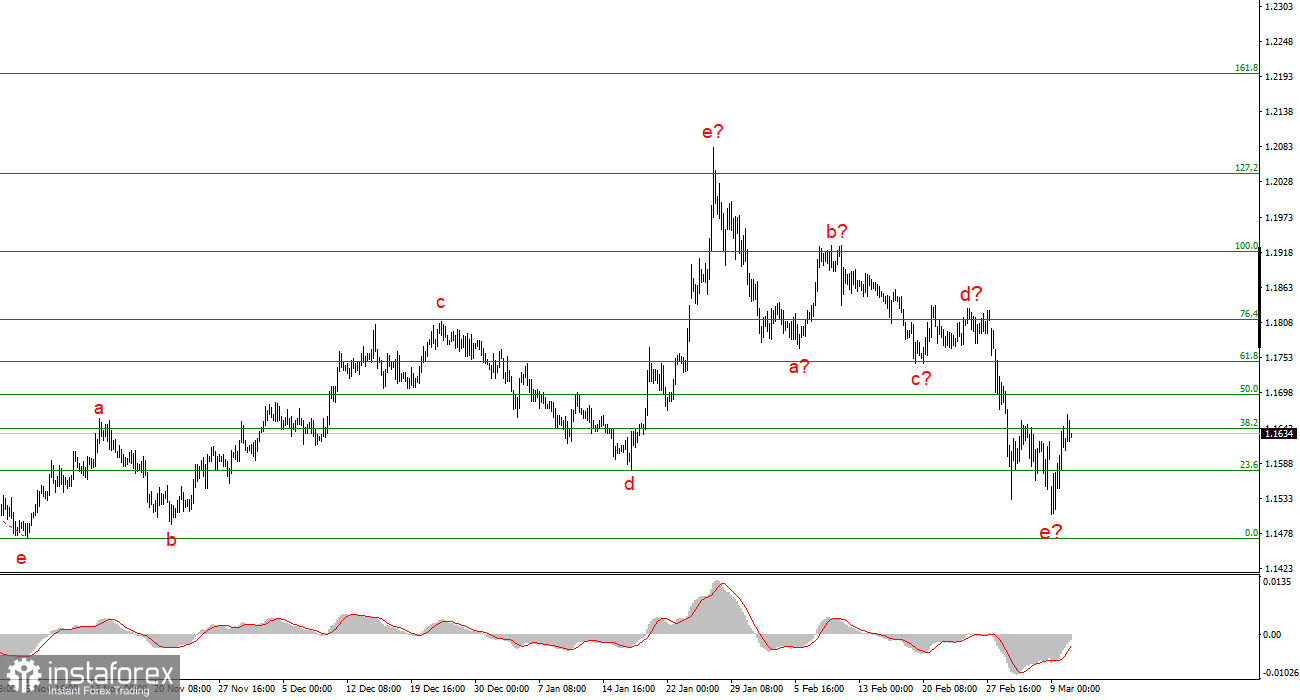
The wave pattern on the 4-hour chart for EUR/USD has taken on a somewhat less desirable form, but it still raises no major questions. There is still no talk of canceling the upward trend segment that began in January of last year—only its internal wave structure is being adjusted from time to time.
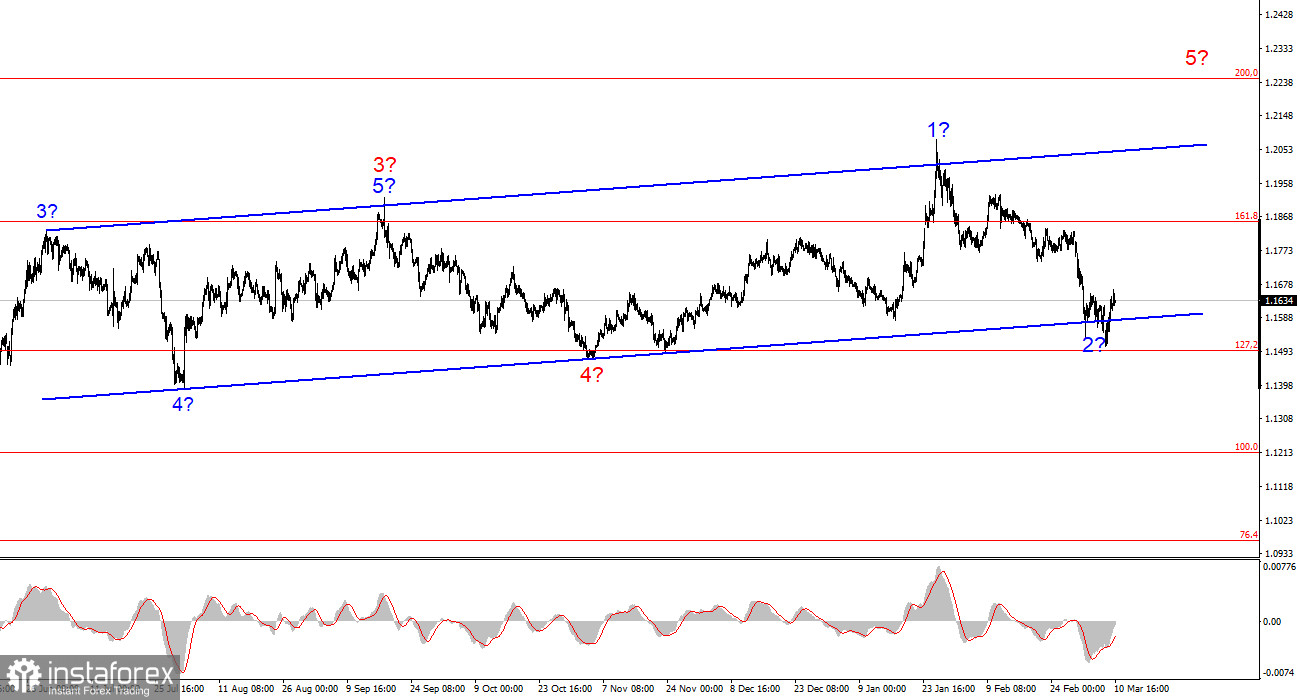
In my view, the pair has completed the construction of global wave 4 (lower chart). If this assumption is correct, then wave 5 is currently being formed. This wave could turn out to be quite extended, with targets reaching as high as the 1.25 level.
The internal structure of the presumed wave 5 is not entirely clear (upper chart). The upward wave sequence cannot be considered impulsive due to rather strong corrective waves. Therefore, at the moment it is interpreted as a-b-c-d-e. However, if wave 5 becomes extended, its internal structure may also become quite complex. I expect the EUR/USD pair to resume its upward movement, while the corrective a-b-c-d-e structure already appears fairly complete. Unfortunately, it may become more extended due to the conflict in the Middle East.
On Tuesday the EUR/USD rate increased by only about 10 basis points and generally continues its restrained recovery. Yesterday Donald Trump said that the war in Iran is nearing its end, as most targets in the country have been destroyed and the top leadership eliminated. According to the U.S. president, only a few facilities remain, and destroying them could take no more than a day.
At the same time, Trump warned that the country's new authorities must not block the Strait of Hormuz, otherwise they will face the same fate as the previous leadership. Based on this, it can be concluded that Trump believes he has achieved his objectives—but those objectives are unlikely to change Iran's political or nuclear course. The destroyed facilities will likely be rebuilt in a few years, and Iran's new leadership will probably pursue the same goals and values as the previous one. You can judge for yourself how justified Trump's claims of success are.
However, the world needs peace—peace in the Middle East and peace in Eastern Europe. So far peace remains elusive. Meanwhile, tomorrow the United States will release its inflation report, which may at least slightly distract market participants from oil and gas prices.
The Consumer Price Index will cover February, so the market may ignore it with a higher probability. Since the war in Iran began and energy prices rose 1.5–2 times, market participants have been more concerned about how much inflation will increase worldwide because of these changes. The February report does not include the Middle East developments, so it is unlikely to attract much attention regardless of the result.
The euro may continue its recovery, which could become the start of a new upward trend segment.
Based on the EUR/USD analysis, I conclude that the pair continues forming an upward trend segment. The policies of Donald Trump and the monetary policy of the Federal Reserve System remain significant factors contributing to the long-term decline of the U.S. dollar.
Targets for the current trend segment could extend toward the 1.25 level. At the moment, I believe the pair remains within global wave 5, which is why I expect higher quotes in the first half of 2026. The corrective a-b-c-d-e structure may finish at any time, as it already looks convincing.
At present, I consider long positions reasonable with targets around 1.2195 and 1.2367, corresponding to 161.8% and 200.0% Fibonacci levels.
On a smaller timeframe, the entire upward trend segment is visible. The wave structure is not entirely standard, as the corrective waves differ in size. For example, the larger wave 2 is smaller than the internal wave 2 within wave 3. However, this does happen occasionally.
It is important to focus on identifying clear structures on the chart rather than rigidly assigning every single wave. At present, the upward wave structure does not raise doubts.
Key principles of my analysis


