
Vea también


 24.09.2026 09:41 AM
Bitcoin trades around $84,000 after a sharp drop yesterday, but still remains noticeably above the so-called max-pain level at $76,000 — the price at which the largest number of option contracts would expire worthless for holders.

Note one of the key events in the derivatives market: the quarterly options expiry on Deribit, with a volume of about $15 billion, scheduled for Friday, September 25. More than a third of all open interest in Bitcoin options on that platform is tied to the September expiry date. Significantly, the put-to-call ratio — a key sentiment indicator between bets on declines and increases — stands at 0.70, indicating a clear predominance of bets on further price rises. The largest concentrations are at strikes of $85,000, $90,000 and $100,000 — precisely the levels the market would target if the current movement continues.
Dealers' current hedging activity, if Bitcoin continues to rise, may temporarily dampen a new rally until the contracts expire, and momentum could resume after those options either expire or are rolled to the next quarterly date. Recall that this options-market dynamic is unfolding against the backdrop of a powerful Bitcoin recovery that began in August, when the US Treasury's announcement of a bond-buyback program pushed most risk assets higher — since then Bitcoin has gained more than 30%.
I do not rule out that price behavior around $85,000 in the coming days will become the main indicator of whether the market gets a continuation of the rally, since the beneficiaries of such an outcome are holders of long positions and call options, while dealers, forced to hedge against the rise, are the side whose actions can temporarily slow the move regardless of fundamental demand.
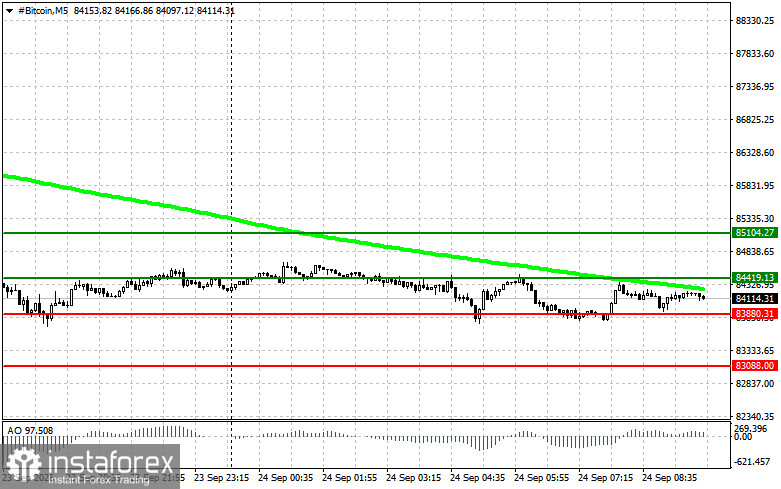
Bitcoin is holding in the $83,000–85,100 range, and the trading plan is built around two mirror directions with a full set of breakout and rebound scenarios. A breakout above $84,400 signals a buy with a target of $85,100, where profits should be taken, and a reversal into a short on a possible pullback should be considered. Mandatory entry condition: price must remain above the 50-day moving average, and the Awesome Oscillator must be in positive territory. The second buy variant works from a rebound: if price approaches the lower boundary at $83,800 but a breakdown is not confirmed, this should be treated as a false move and a long opened, first targeting $84,400 and then $85,100 as a wider technical target in case the rise continues beyond the near range.
Sales are constructed in the opposite direction. A confirmed break below $83,800 leads to a short position targeting $83,000, with mirror conditions: the moving average above price and the Awesome Oscillator below zero. The second sell variant works from a rejection at $84,400 if an upside breakout fails to confirm, opening a path for a short first to $83,800 and then to $83,000.
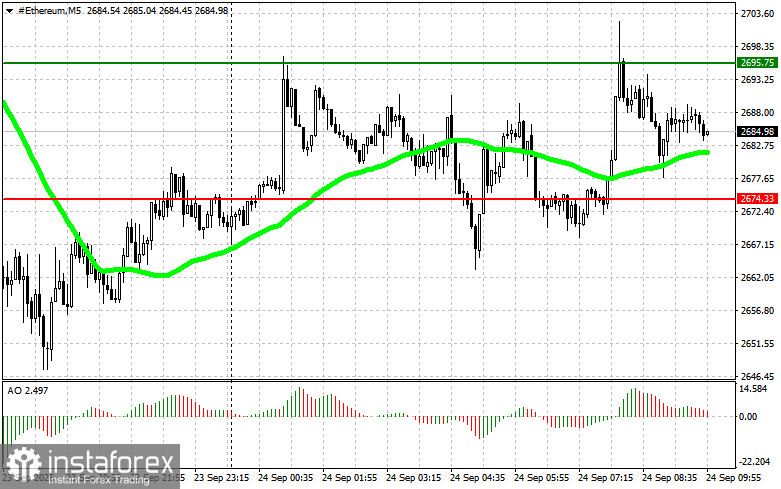
Ether is trading in the $2,641–2,714 range, and the logic fully mirrors Bitcoin on its own price scale. A breakout above $2,695 gives a buy signal, targeting $2,714 under the same conditions: a rising moving average below price and the Awesome Oscillator above zero. The second buy variant works from a rebound at $2,674 if a breakdown is not confirmed, aiming first for $2,695 and then $2,714 as a wider target for continuation.
Sell positions on Ether begin on a break below $2,674, targeting $2,641, given price above the moving average and Awesome in negative territory. The second sell variant works from a rejection at $2,695 if an upside breakout fails to confirm, targeting a return to $2,674 and then $2,641. Both indicators serve solely as filters to weed out false moves, not as independent reasons to enter early, so decisions are made only after price actually confirms the specified levels.


