
Veja também


 08.12.2025 12:54 AM
The American dollar will set the tone for the entire currency market in the coming week. However, if my readers have just entertained the thought of a busy economic calendar, I must burst that bubble. The "shutdown" continues in effect in the US. While the shutdown itself has ended, the Bureau of Labor Statistics and other government agencies have not yet been able to gather all the necessary information or fill the statistical gaps. For example, the next reports on the labor market, unemployment, and inflation will only be released next week, on December 16 and 18. This means they will come after the FOMC meeting.
I have often discussed the impact of the lack of statistics on the Federal Reserve's decisions. The central bank will once again have to act almost in the dark. On the one hand, the labor market continues to experience problems, as the ADP report indirectly confirms. However, ADP is not the most accurate indicator; it likely only allows for tracking very general dynamics. Therefore, the FOMC Committee will probably play it safe and conduct a third consecutive round of policy easing. Next year, the Fed will be guarding against inflationary pressures rather than a further "cooling" of the labor market. In my opinion, on Wednesday, we will see the last rate cut before a prolonged pause.
In this context, Jerome Powell's speech will be a significant event. Powell may hint at the market how the Fed plans to act moving forward. I do not doubt that the "dove trio" will continue to vote for easing, but Powell and his "independent colleagues" will shift their focus to their second mandate—price stability. Powell will likely emphasize inflation in his Wednesday speech. However, there is nothing positive for the US dollar in this. A pause in easing is not the same as tightening policy. The market has been taking into account non-existent interest rate cuts for a couple of years, pricing in much more easing than the Fed can actually provide. In my view, announcing a pause will not significantly help the dollar, and if the market wants to continue developing a corrective structure, it will do so, with or without Powell. Recently, the market has had ample reasons to sell the dollar, though we have not seen that reflected.
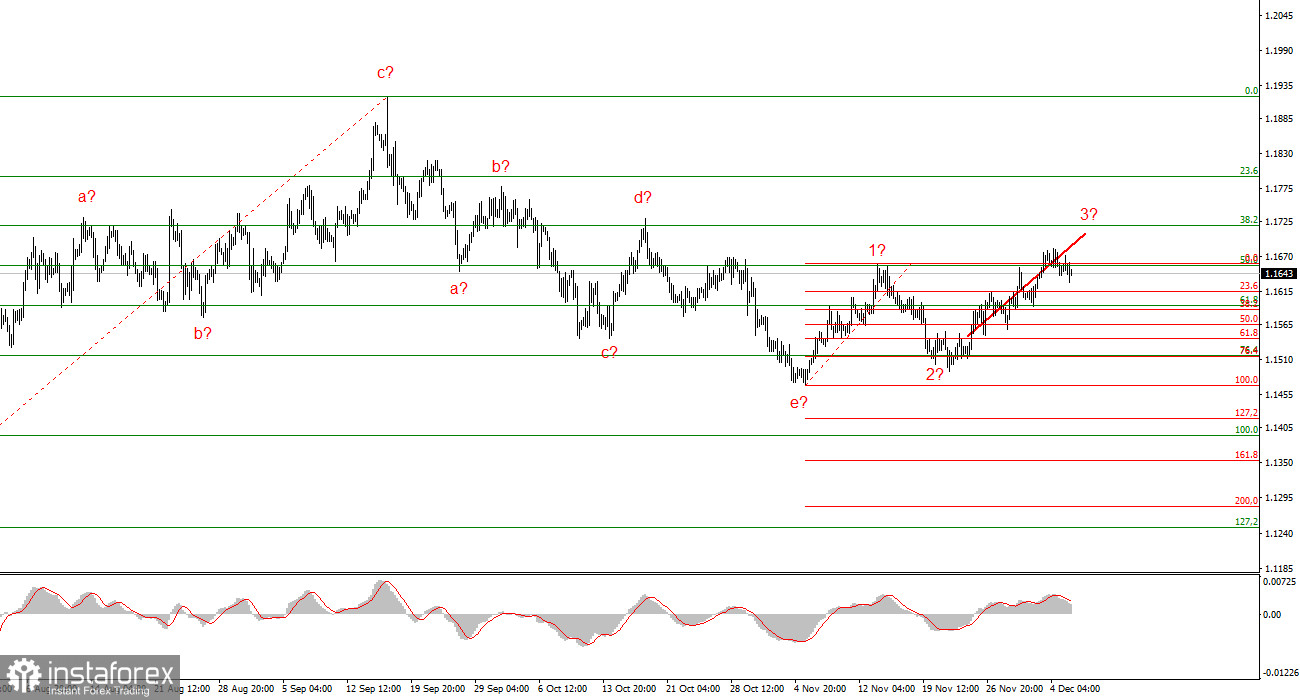
Based on the analysis of EUR/USD, I conclude that the instrument continues to build on the upward section of the trend. The market has paused in recent months, but Donald Trump's policies and the Fed's actions remain significant factors in the US dollar's future decline. The targets for the current trend section could extend up to the 25th figure. However, the last upward segment has once again taken on a corrective appearance; thus, a downward wave within this segment may begin, with a maximum leading to a new downward corrective set of waves.
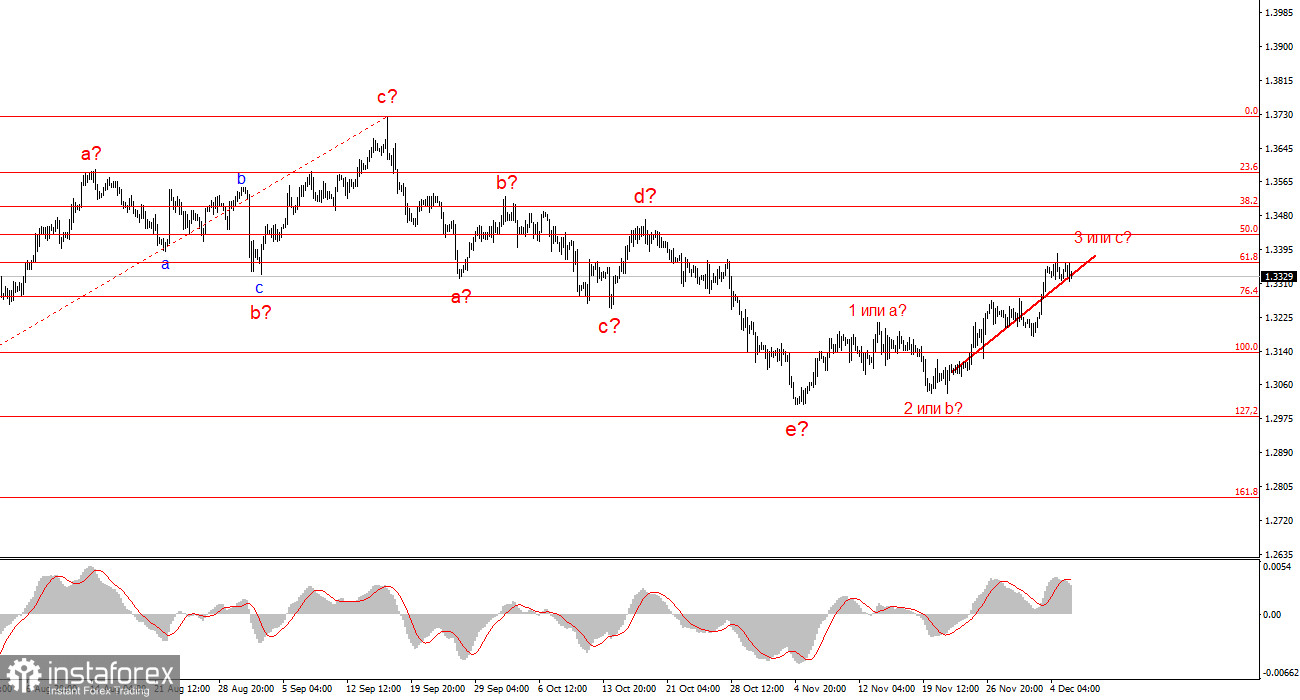
The wave picture for GBP/USD has transformed. We continue to deal with an upward impulse section of the trend, but its internal wave structure has become complex. The downward corrective structure a-b-c-d-e in C of 4 appears quite complete. If this is indeed the case, I expect the main trend section to resume its build with initial targets around the 38 and 40 figures. However, wave 4 itself may also take on a five-wave appearance.
In the short term, I anticipated the formation of wave 3 or c with targets around 1.3280 and 1.3360, corresponding to the 76.4% and 61.8% Fibonacci levels. These targets have been achieved. Wave 3 or C may continue its build, but the current wave set is likely corrective again. Consequently, a decline at the beginning of next week is also possible, and the attempt to break the 1.3360 mark has been unsuccessful.


