
Veja também


 23.07.2026 12:46 AM
On Thursday, the European Central Bank will hold its next meeting, and most analysts and market participants agree that the ECB will keep all three interest rates unchanged. This is supported by the slowdown in inflation in the Eurozone to 2.8% in June. However, experts also note that the likelihood of a second consecutive round of monetary policy tightening remains. A rate hike for the second time in a row will be implemented if the ECB's medium-term inflation forecasts indicate further increases.
We cannot judge the ECB's forecasts, but it is clear that no slowdown in the consumer price index is expected by the end of July. Brent crude oil has risen to $93-94 per barrel and may exceed $100 by Friday. Consequently, oil prices will return to a range that has previously shocked the markets. If the Strait of Hormuz is not unblocked soon, the $100-120 per barrel range will become the norm. Throughout the active phase of the conflict in March-April, oil prices were indeed in this range. As a result, inflation could also return to the levels seen in April-May. In this case, the ECB will need to resume tightening policy; the only question is whether the central bank will choose to act preemptively.
Christine Lagarde stated during the economic forum in Sintra that the rate hike in June was a reaction to rising inflation. According to ECB forecasts, inflation is not expected to return to 2% before the end of 2027, and only with continued monetary policy tightening. If rates have to be raised to achieve lower inflation, what difference does it make when exactly? Based on this, the likelihood of a tightening in ECB policy is not that low.
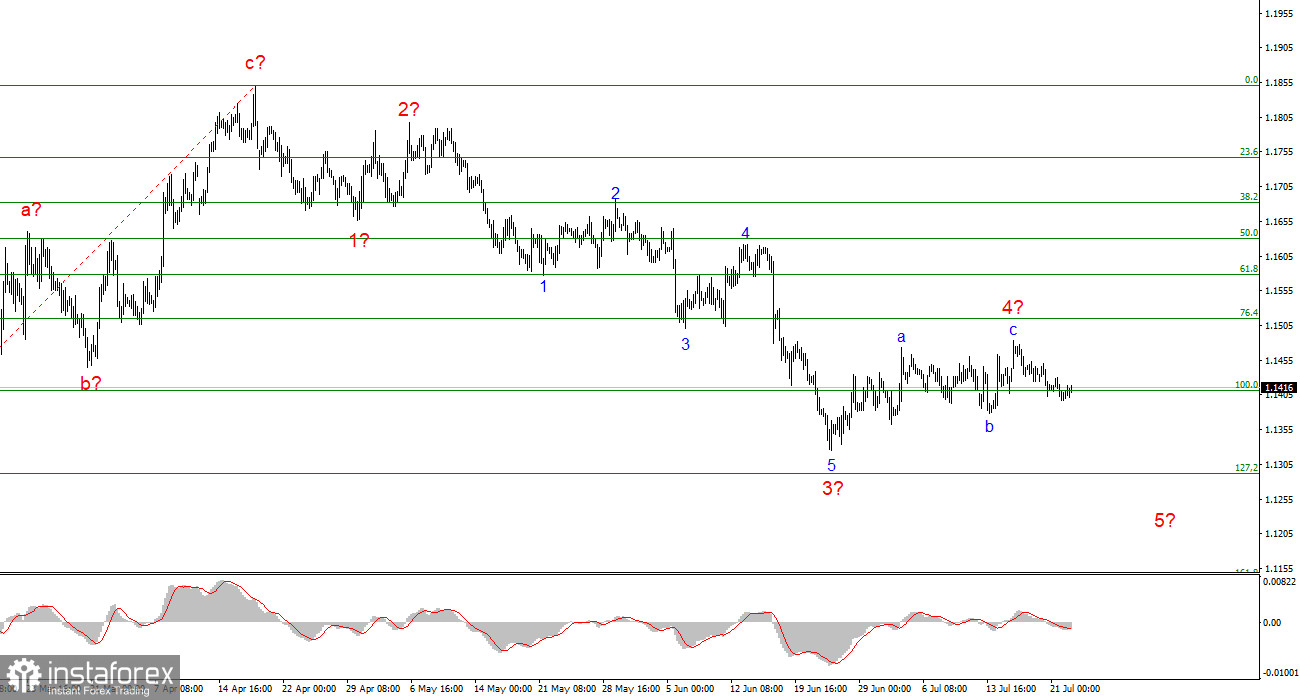
But what benefit could the euro gain from a "hawkish" move by the ECB? In my opinion, none. A month and a half ago, the market simply ignored the tightening of policy, although the ECB remains the only G7 central bank to raise rates in response to the energy crisis and rising prices. Therefore, a similar move in July or September may also not impact the euro's exchange rate. According to the current wave analysis, the EUR/USD instrument has not yet completed the formation of its downward trend segment, and the market is in no hurry to buy euros. Thus, if we do see a rise in the euro, it will likely occur after the completion of wave 5 in C. Only then might the market take notice of the ECB's rate hikes.
Based on my analysis of EUR/USD, I conclude that the instrument remains within an upward trend segment, while in a shorter-term perspective, it is within a downward trend segment. In my opinion, it is a good time to attempt to establish long positions, though the instrument may still drop to the 13th figure as part of wave 5 in C. Wave analysis often brings surprises, so I would start to readjust towards buying.
The wave analysis for the GBP/USD instrument has taken on a rather complex form. The instrument has currently completed three waves down, while EUR/USD could form five waves. Thus, the British pound may also form one more wave down, as will the euro, but this wave could be the second one within a new upward trend segment. Therefore, the divergence in wave structures of the euro and pound will exist but will likely be insignificant. Based on this, I anticipate a downward pullback soon, followed by the development of a new upward trend segment, with initial targets located around the 37-38 figures.


