
Veja também


 29.07.2026 01:21 PM
Bitcoin reached the $64,700 level, after which a small correction began. Ethereum continues to trade around $1,900, preparing for the important Fed meeting, which was discussed in detail in the morning review.

While traders are waiting for new market signals, an interesting report has drawn attention. According to the report, the first half of 2026 was the most active period in the history of the cryptocurrency industry for hackers in terms of the number of incidents.
According to the analytical platform Blockaid, total losses from hacks exceeded $1.1 billion as a result of 212 confirmed incidents, which is 3.4 times higher than the number of major exploits recorded throughout 2025. At the same time, the total amount of losses was lower than last year, when it was inflated by the single $1.5 billion Bybit hack. Therefore, the record number of incidents in the current half-year reflects not the scale of individual attacks, but the systemic growth in the frequency and diversity of threats.
The structure of losses has changed significantly compared with previous years. Ethereum leads in terms of stolen funds, with losses of around $332 million, mainly due to code exploits and application-level vulnerabilities. Solana was almost equal, losing around $326 million, but the nature of these losses is fundamentally different: more than 98% resulted from the compromise of private keys and transaction-signing infrastructure rather than smart contract bugs.
The largest individual incident remains the $292 million KelpDAO hack carried out through a forged cross-chain message.
As for short-term trading, the strategy and conditions are described below.
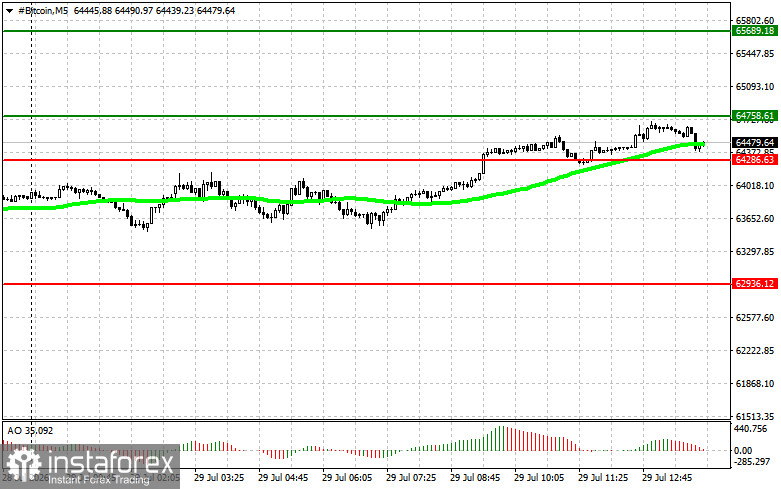
Scenario #1: Today, I will buy Bitcoin when the entry point is reached around $64,700, with a target of growth towards the $65,500 level. Around $65,500, I will exit long positions and immediately sell on a rebound. Before buying on a breakout, it is necessary to confirm that the 50-day moving average is below the current price and that the Awesome Oscillator is above zero.
Scenario #2: Bitcoin can be bought from the lower boundary of $64,200 if there is no market reaction to its downward breakout, with a return towards the levels of $64,700 and $65,500.
Scenario #1: Today, I will sell Bitcoin when the entry point is reached around $64,200, with a target of a decline towards the $62,900 level. Around $62,900, I will exit short positions and immediately buy on a rebound. Before selling on a breakout, it is necessary to confirm that the 50-day moving average is above the current price and that the Awesome Oscillator is below zero.
Scenario #2: Bitcoin can be sold from the upper boundary of $64,700 if there is no market reaction to its upward breakout, with a return towards the levels of $64,200 and $62,900.
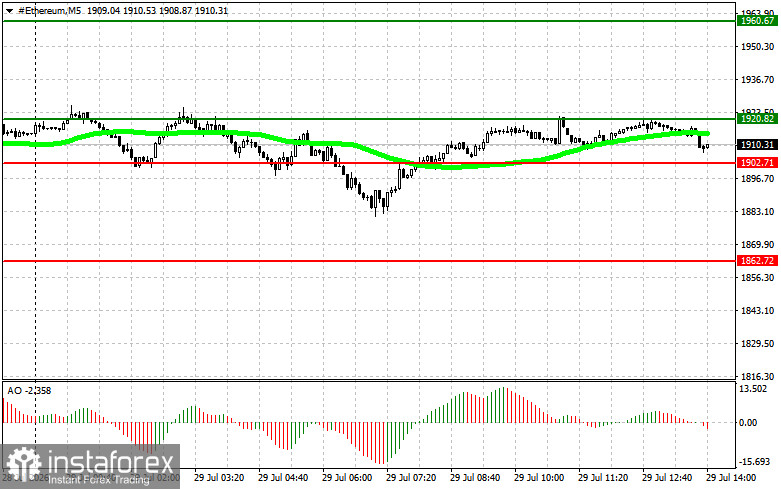
Scenario #1: Today, I will buy Ethereum when the entry point is reached around $1,920, with a target of growth towards the $1,960 level. Around $1,960, I will exit long positions and immediately sell on a rebound. Before buying on a breakout, it is necessary to confirm that the 50-day moving average is below the current price and that the Awesome Oscillator is above zero.
Scenario #2: Ethereum can be bought from the lower boundary of $1,902 if there is no market reaction to its downward breakout, with a return towards the levels of $1,920 and $1,960.
Scenario #1: Today, I will sell Ethereum when the entry point is reached around $1,902, with a target of a decline towards the $1,862 level. Around $1,862, I will exit short positions and immediately buy on a rebound. Before selling on a breakout, it is necessary to confirm that the 50-day moving average is above the current price and that the Awesome Oscillator is below zero.
Scenario #2: Ethereum can be sold from the upper boundary of $1,920 if there is no market reaction to its upward breakout, with a return towards the levels of $1,902 and $1,862.


