
Veja também


 08.09.2026 09:49 AM
Bitcoin and Ether continue to fall after a failed recovery attempt made earlier this week, and the asset slipped below $79,000, returning to pre-rally levels under $80,000.

Before buying at these levels, it is worth looking at one very interesting figure. Very recently, unrealized profit of short-term whale holders reached a record $9.07 billion, the highest since observations began in 2016. By Saturday, the metric had pulled back to $7.51 billion following a small price decline, but it remains among the five largest values ever recorded — and all five records were set literally in the last two weeks.
A profit of this magnitude on paper at that scale is exposure. A cohort sitting on record unrealized gains can become sellers the moment price wobbles. That benefits market participants who plan to buy Bitcoin cheaper after a pullback, but it hurts those who already hold long positions from recent entries, since they will be the first tempted to realize profits at the slightest sign of weakness. The causal chain is straightforward: the higher the unrealized profit of short-term whales, the greater the probability they will start selling at early reversal signals, and mass selling in turn accelerates the very decline that triggered it.
Does this threat amount to a death sentence for the rally? Not necessarily, because the cost-basis structure indicates the floor under the rally is real, but the unrealized profit sitting on top of it means that this floor is being stress-tested by its own success. In other words, the recent rapid price rise created a layer of short-term holders with large paper gains, but it did not erase the more fundamental purchase structure supporting the price from below.
In my view, the key point is the unrealized nature of the profits — the record itself does not guarantee an immediate wave of selling but marks a vulnerable zone where holder psychology can flip sharply if price continues lower. If Bitcoin consolidates or slides in the coming days, the risk that short-term whales begin mass profit-taking will grow, so the behavior of these large players — not the general news flow — will determine whether the market holds above this week's local lows.
As for short-term trading, the strategy and conditions are described below.
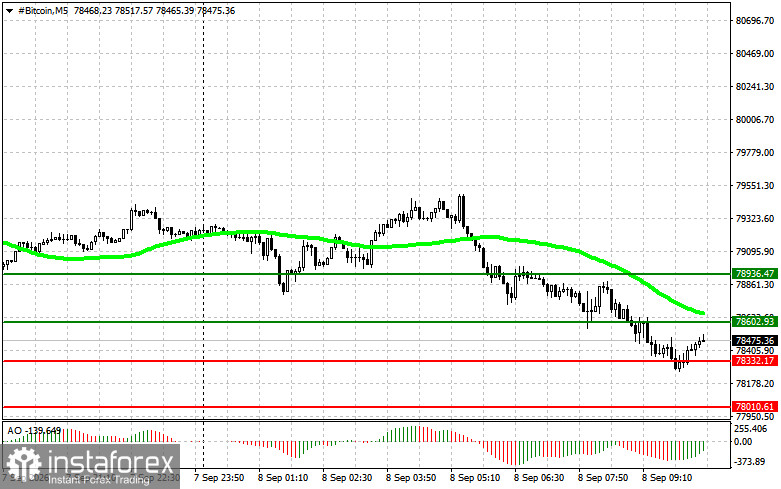
Bitcoin is currently trapped in a narrow range between $78,300 and $78,900, and the trading plan centers on two mirror scenarios: breakout trades and rejection (mean-reversion) trades. If price reaches about $78,600 and pushes higher, I will open a long position targeting $78,900; there, I will take profit and immediately flip into a short position for a potential retracement, because a sharp impulse after a breakout often peters out at the nearest resistance rather than cruising through it. Before entering such a trade, confirm two things: the 50-day moving average must remain below the current price, confirming the medium-term bullish background, and the Awesome indicator must be above zero, showing buyer momentum has not yet exhausted.
The alternative scenario for a long assumes price falls to the lower boundary $78,300, but the market fails to react to a break below it — treat that as a false breakout and open a long from that level with an initial target of $78,600 and then $78,900.
Shorts are fully symmetrical to longs, inverted. On a confirmed break below $78,300, I will open a short targeting $78,000, and there look for a reversal into a long on the bounce, since moves rarely proceed without a correction after the first significant target is hit. Entry conditions mirror the long rules: the 50-day MA should be above price and Awesome should be negative. The second short variant is a rejection off the upper boundary $78,600 with no reaction to its breakout above — that opens a path to the lower targets $78,300 and $78,000 in sequence.
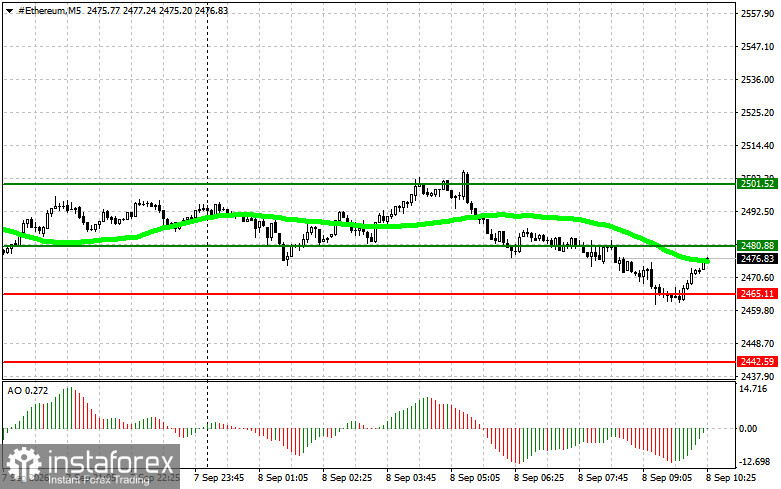
Ether trades on its own price scale but follows the same logic. Ether is trading in the $2,442–2,501 range.
Both indicators are used as filters to cut false signals, not as sole triggers. Enter trades only on real price confirmation at the marked levels, not solely based on the MA or oscillator position.
Risk reminder: high unrealized profits among short-term whales create a zone of vulnerability — exercise strict risk management, keep stops tight, and size positions so that a cascade of whale profit-taking cannot blow your account.


